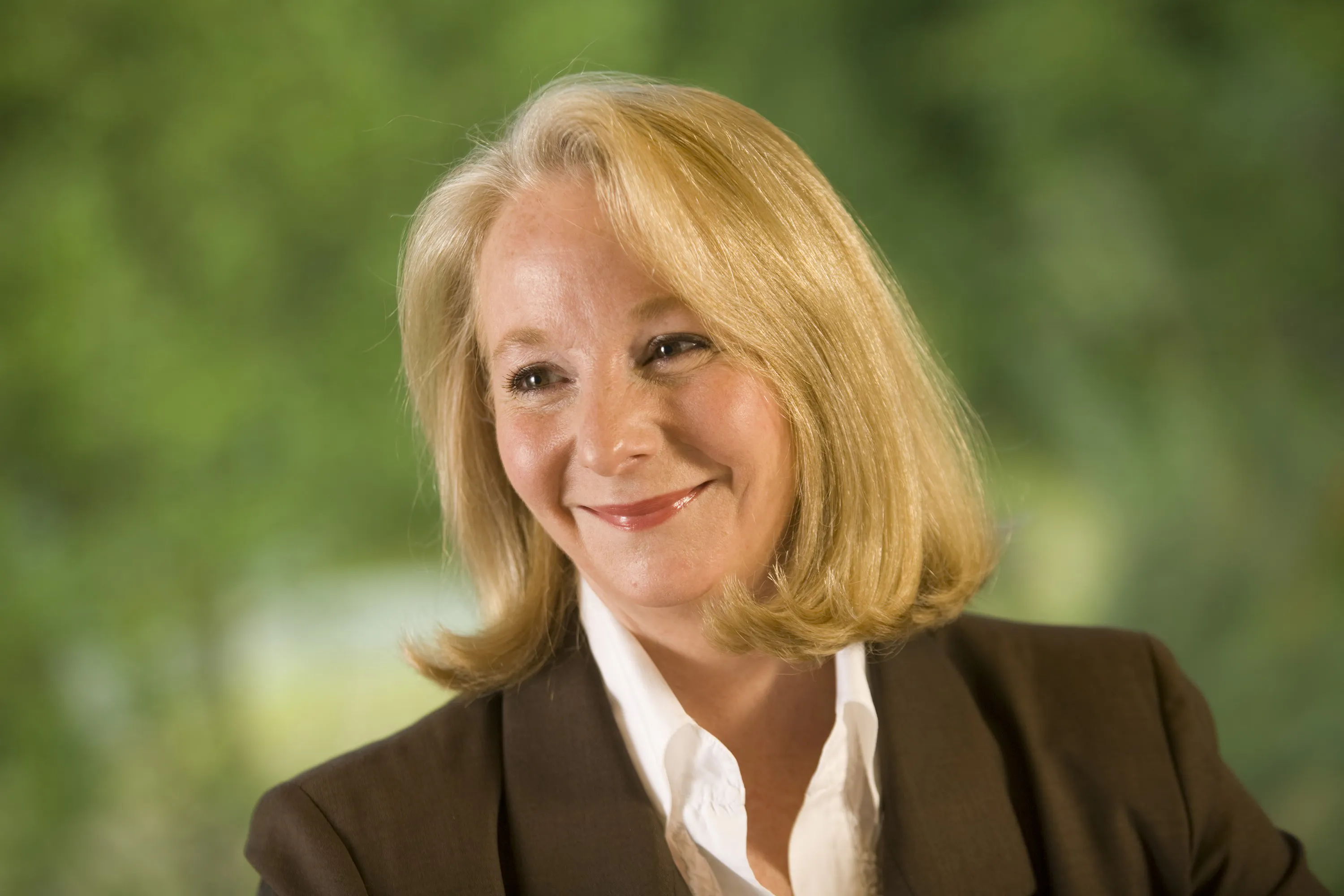



How to serve on a third sector board | Susan Boster in conversation with Marty Wikstrom
Marty Wikstrom has over 35 years’ experience in supporting global brands with strategy, execution, distribution and creative development.
She began her career at Nordstrom, Inc. where, over 19 years, she rose from part-time sales assistant to President of the Full Line Stores Group.
Marty was Managing Director of Harrods, Ltd. and went on to serve as a Non-Executive Director of Compagnie Financière Richemont SA, the world’s second-largest luxury conglomerate, where she also led the Fashion and Accessories brands as CEO.
She has held many Board seats in the luxury, technology and sustainability sectors and is currently Chairman of Fortnum & Mason Plc and a Non-Executive Director of Johnstons of Elgin Ltd.
Marty is a member of the Advisory Board at Cambridge Judge Business School as well as a Fellow of the Wo+Men’s Leadership Centre.
In 2017, Marty was inducted into the World Retail Congress Hall of Fame. The following year, she was selected as one of Retail Week’s ‘8 Women’ who have broken down barriers. In 2019 Forbes named her as their Retailer of the Year and in 2025 Marty was presented with the Leading Light Award from the International Women’s Forum.
What boards, private and non-profit, do you currently sit on, and which have you sat on in the past?
Currently, I am the Chairman of the Board of Fortnum and Mason. I am a longtime board member of Johnston's of Elgin, a beautiful and historic textile company that manufactures many of the world’s leading luxury brands. I am on the Advisory Board of Cambridge Judge Business School and a Fellow of the Wo+Men’s Leadership Centre at The University of Cambridge.
Previously, I served on the boards of Compagnie Financière Richemont SA, Farrow & Ball, The Rug Company, Harry’s of London, SpaceNK, and more.
On the non-profit side, I was on the Board of the World Wide Web Foundation for almost six years. I was on the Board of Directors for the International Women's Forum and the International Women's Forum Leadership Foundation. These two Boards have now merged.
What first prompted you to serve on nonprofit boards?
I keep this Mohammed Ali quote on my desk as a reminder: “Service to others is the rent you pay for your room here on Earth.” I think that if you do well, you have to do good.
Before accepting a Board seat of a nonprofit, look at the organisation: do you really believe in what it is doing for your community, or for the world? Does it have good leadership? It doesn't make any difference if it is for-profit or non-profit … it must have rigorous leadership.
Looking back to the boards you've been on, to what extent do the choices reflect your personal passions versus your professional interests?
Hopefully, you combine your passion with a business that is within your scope of interests. And if you can leverage your expertise, then all the better.
I also take a deep look into how much of the money raised actually goes into the projects that they are supporting. I look for organisations which put at least 80% back into actual programming and impact work and keep their overheads really limited.
How did your luxury background allow you to contribute uniquely to conversations in non-profit settings?
Let’s take a global organisation as an example. We're not only managing a non-profit, but many different jurisdictions and cultures around the world. With that comes challenges on the people front. My leadership perspective is through the lens of bringing the conversation back to what it is we are trying to do, what our strategy is and how we are going to deliver results. I find that there are a lot of similarities between for-profit and non-profit settings, because in both you are just trying to solve problems. You are trying to deliver a product.
During your tenure as development Chair of the IWF foundation, you helped establish an endowment fund to support the next generation of women leaders. How did you approach setting up a new endowment fund, and what advice would you give to other board members or executives looking to deliver that kind of legacy?
Endowments are incredible but they do have their challenges as well as strict regulatory oversight. Are you going to allow people to have named endowments if they give above a certain level? Do they get to direct the funds from their endowment, or not? You want to give your donors some flexibility, but you also have to be absolutely sure that you know why each donor is getting involved and what they want out of it. You have to keep track of it and put in standards upfront. My best resources and information came from conversations with others who had set up their own endowments. While initially challenging and requiring a great deal of ongoing administration and responsibility, focusing on meeting the needs of your sponsors will guide you through.
I will also say that a huge part of the IWF endowment came from $100, $200, $500, $1,000, $2,000 and $5,000 donations to get to the millions we eventually raised; it wasn’t just five to six checks for $1 million each. It was really hard, but in hindsight, I think it speaks to one of the great things about the organisation. So many people felt that they had a hand in the success of the organisation, and they participated in building that endowment.
How do you personally define success on a non-profit board versus a for-profit board?
The best boards [in either sector] have metrics, and they analyse these metrics to determine whether the organisation is achieving its goals.
On a for-profit board, you have very specific metrics, goals, and strategic plans. And numbers don't lie - you either make your year, or you don't make your year. You are on that board to protect the interests of the shareholders.
A non-profit board has a mission, and tied to that mission, you should have standards, expectations and KPIs, even if they are mission-driven versus finance-driven. Your job is to determine what the organisation can do, how long that is going to take, whether the three- or five-year strategic plan is good enough to achieve that, and whether the organisation can actually follow that plan.
I always say my personal mission on any Board is to leave it better than I found it.
How do you feel the leadership dynamics differ between corporate board meetings and non-profit board meetings, if at all?
I have been in a lot of different for-profit contexts. Some of the meetings will go on for the whole day, but in some of the most rigorous public companies, the whole meeting happens before the actual meeting - so when you get to the meeting, it is all scripted and moves quickly.
In my experience, non-profit boards tend to be much larger and it is more challenging to reach a consensus.
When have you gotten it wrong, and what did you learn?
Is this before breakfast or after?
It would be hard to imagine anyone claiming they have not made mistakes, or they have not had ups and downs. Even if, as a whole, your career is brilliant, you have made mistakes. All you have is time, and space, so how quickly can you can you modify and change?
I always say no matter how experienced you are, the more you know, the more you know you don't know. Business changes all the time. Supply chain changes, people change, technology changes. It is in your best interest not to become arrogant or complacent - have curiosity and a learning mindset at all times.
What advice would you give to someone who's joining their first board in any sector?
We have one mouth and two ears for a reason. Listen, listen, listen, learn. When you walk into a boardroom, you can have all kinds of preconceptions. But those will most likely not be the reality.
The first year you are on a board, you must learn everything you can. I call it the MBWA – Manage By Wandering Around. Wander around and learn about the business; if it is a non-profit, go see what the delivery is. You might have observations and insights that are very important, and you may be informed by your expertise. It takes quite a long time, usually a full year, to come up to speed on a board, and you're never going to have all the answers. You really start to perform in your second and third years.
Susan Boster is the Founder and CEO of Boster Group Ltd., an award-winning independent consultancy specialising in the development of innovative partnerships between global corporations, cultural institutions and impactful foundations. Boster Group advises leading corporations on building and elevating their partnerships, connecting strategy and activation to clear, measurable business outcomes. Boster Group has overseen the transfer of more than $100 million to cultural and impact partners and delivered measurable results to its clients around the world. Current and former clients include Tishman Speyer, BNP Paribas, General Electric, J.P. Morgan, Moët Hennessy, EY, AMEX, Diageo, Goldman Sachs, Gap Inc., Meta, Bacardi, Montblanc and Disney.
Previously, as Marketing Director at Barnes & Noble and later CMO at News International, Susan oversaw the transitions of both companies to e-commerce and digital platforms, including the launch of barnesandnoble.com. Susan is Deputy Chair of the Design Museum and is an Advisor to The Representation Project. She previously served as a Trustee at the Donmar Warehouse and as Vice Chairman of the English National Ballet. Susan is regularly featured as a moderator and keynote speaker at conferences, such as the World Economic Forum, at the Cannes Festival of Creativity, SXSW and the Mobile World Conference. She is a Consultant Lecturer at Sotheby’s Institute of Art.
You might also like

How to serve on a third sector board | Susan Boster in conversation with Ed Williams

How do I step up to chair positions?
How do I access board roles?